
This year, Colombia commemorates the 20th anniversary of the Justice and Peace Law, which established the country’s first formal transitional justice mechanism. While the country has achieved a great deal in way of peace and justice over the past two decades, it remains deeply wounded by past violence and persistent divisions. It is thus essential on this milestone anniversary to reflect on the evolution that led to the groundbreaking law, the lessons that have been learned so far, and the challenges that lie ahead.
In July 2005, Colombia passed Law 975, known as the Justice and Peace Law. The law provided a framework for the demobilization of illegal armed groups, though in practice it was applied primarily to the United Self-Defense Forces of Colombia (AUC). It sought to address the grave human rights violations and breaches of international humanitarian law committed during decades of armed conflict by imposing alternative sentences on those responsible in exchange for truth telling and reparations for the victims.
ICTJ began its work in Colombia in 2005, coinciding with the law’s enactment. From the outset, ICTJ has provided critical support to its implementation on multiple fronts: assisting the Attorney General’s Office, analyzing and resolving operational bottlenecks, proposing solutions to strengthen the law’s application, and conducting practical research on a macro-criminal approach to investigation and prosecution.
A macro-criminal approach seeks to identify criminal patterns across isolated incidents with a view to holding accountable those most responsible for large-scale atrocities. Through this lens, ICTJ has supported efforts to contextualize crimes within broader social and political frameworks, prioritize cases strategically, and address the systemic nature of violations. The lessons drawn from this work remain highly relevant to Colombia’s ongoing pursuit of justice and reconciliation.
The Justice and Peace Law has provided an important foundation for Colombia’s broader transitional justice process, particularly with regard to ensuring victim participation in criminal proceedings, judicial contributions to truth seeking, and the use of alternative sentencing. The Special Jurisdiction for Peace, created under the 2016 peace agreement between the government and the Revolutionary Armed Forces of Colombia – People's Army, builds on this foundation by taking a macro-criminal approach to address war crimes and crimes against humanity committed by diverse actors. As the government pursues peace with other armed groups, the Justice and Peace Law, its implementation, and the lessons learned from it continue to inform the design of effective transitional justice mechanisms.
To commemorate the 20th anniversary, ICTJ is spotlighting publications and multimedia initiatives that explore the Justice and Peace Law and its legacy. These include a podcast, coproduced by ICTJ and Sillón Estudios, that revisits the peace process with the AUC and considers its relevance to today’s peace efforts, as well as an investigative report series, coproduced by ICTJ and Verdad Abierta, that examines the law’s impact, progress, and future outlook.
ICTJ has also compiled a collection of its publications related the Justice and Peace Law and Colombia’s transitional justice process. Together, these publications reflect the organization’s sustained and multifaceted engagement in the country over the years. They include analyses of case selection and prioritization, research on developing a macro-criminal approach, and reflections on acknowledgment of responsibility, among others. Below is the list of publications, which can be accessed by clicking on the titles.
___________
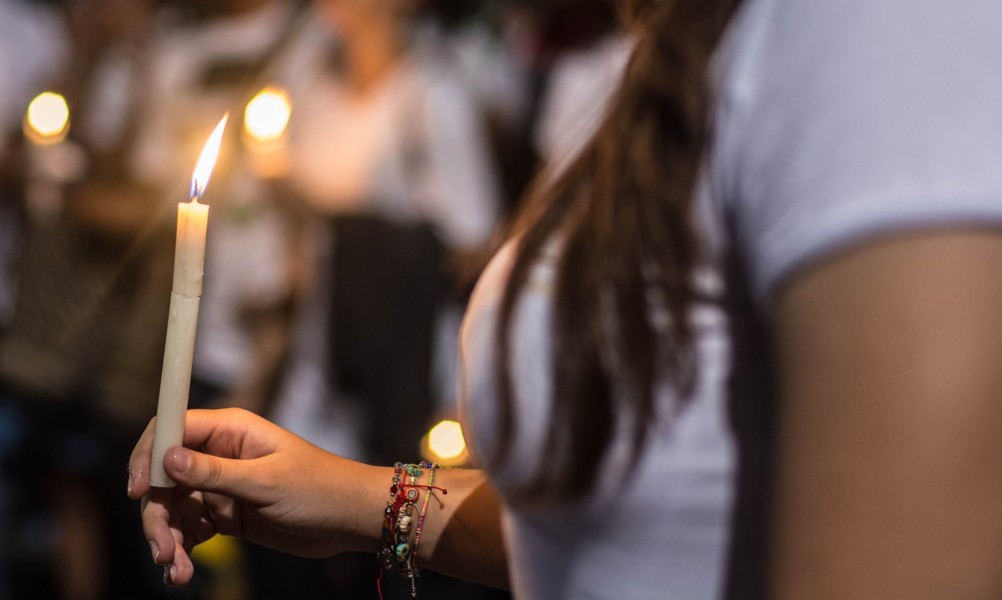
PHOTO: A woman holds a candle at a pro-peace demonstration in Barranquilla, Colombia, in October 2016. (María Margarita Rivera/ICTJ)