39 results

ICTJ strongly advocates for a holistic transitional justice vision for Ukraine as part of its programmatic activities. Leading this work is the head of ICTJ’s Ukraine program, Kateryna Busol. She is the author of the new report, “Myths and Ways Forward: Transitional Justice for Ukraine." In this interview, Busol discusses the path toward holistic justice for the country.

A new ICTJ report urges the revitalization of Ukraine’s holistic transitional justice policymaking. Debunking the most common myths about transitional justice in Ukraine, the report presents the key legal, policy, and victim-centered arguments in favor of advancing a comprehensive transitional justice framework.

Despite earlier efforts to envision a national transitional justice policy, Ukraine remains overly cautious about establishing one. This report provides a robust substantiation of why Ukraine should revive its holistic transitional justice policymaking. In the first part, it debunks t...

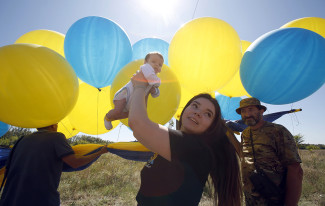
A women holds up an infant in the air on sunny day outdoors, surrounded by yellow and blue balloons

Bogotá, November 20, 2020—ICTJ and the Movement of Latin American Hip Hop Expressions have joined forces to cohost the third International Hip Hop Encounter, which will take place virtually this week from November 25 to November 28. The four-day online event will bring together artists and musicians from across Latin America and Africa along with activists, social leaders, and civil society representatives. The festival’s theme is the role of hip hop music and culture in uncovering truth, preserving memory, and resisting violence and oppression.

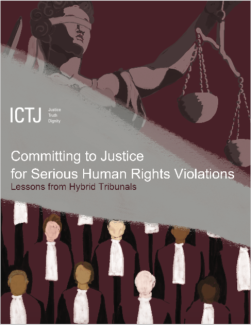
This report aims to help practitioners in the transitional justice field to understand the experience of establishing and operating hybrid courts and to address some common assumptions about these entities. To do so, it looks at hybrid or mixed courts in practice, drawing on experienc...

ICTJ was pleased to host the newly elected United Nations Special Rapporteur on the promotion of truth, justice, reparations, and guarantees of non-recurrence, Fabian Salvioli (Argentina), at its New York office, where he discussed his vision and priorities.

As we look back on 15 years of ICTJ's work, we recognize that our greatest asset is the people whose knowledge, experience, and dedication made our contribution possible. To celebrate all who have been part of ICTJ’s story over the years, we asked some of our former colleagues to share their reflections and memories of moments that stand out: moments that throw the stakes of our work into sharp relief. In the weeks and months to come we will bring you their stories in Reflections on the Struggle for Justice. Caitlin Reiger, ICTJ's former Deputy Director of Prosecutions (2005–2010), reflects on the humanizing power of testimony, on display in East Timor.

ICTJ spoke with Patrick Walsh, an Australian human rights advocate who helped establish and advise East Timor's Commission for Reception, Truth, and Reconciliation (CAVR).

Some of the relatives’ stories start with the banging of a door at night, followed by a sudden abduction; others begin with a seemingly innocent citation to appear at a police station for a “routine procedure”. In any case, the stories always unfold in a desolate manner: as a loved one ...

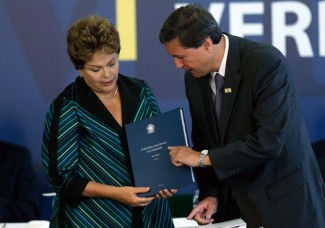
ICTJ welcomes the release of the final report of Brazil’s National Truth Commission after two and a half years of work to unveil the truth about serious human rights violations that took place in the country between 1946 and 1988, especially during the military dictatorship of 1964 to 1985. The final report is a historic contribution to truth and justice in a country where serious crimes have remained unaddressed for decades and calls on the Brazilian judiciary to disregard the Amnesty Law and act in cases of crimes against humanity.