
574 results

ICTJ filed an amicus brief in the apartheid reparations case before the Southern District Court of New York on November 25, 2009. The brief supports a decision by the South African Government not to oppose legal action against five international companies that are accused of aiding an...

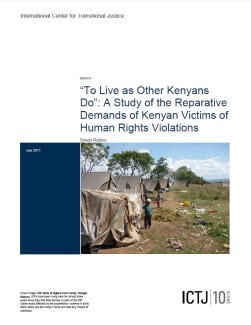
As Kenya continues to address its 2007-08 postelection violence, greater emphasis should be placed on victims’ reparative justice demands, according to a new ICTJ report. The report, “To Live as Other Kenyans Do”: A Study of the Reparative Demands of Kenyan Victims of Human Rights Violations, is a...

This paper documents the opinions of victims of human rights violations in Kenya about the country’s unfolding transitional justice process. The first section gives background into the human rights violations; the second section presents victims ideas about reparative justice. The rep...

The South African Coalition for Transitional Justice (SACTJ) submits the following comments regarding the May 11, 2010 General Notice 282 published in the Government Gazette. The Coalition objects to the Notice 282 regulations on procedural, constitutional, and international law groun...

On May 11, the South African Department of Justice and Constitutional Development (DOJ) invited comments on new regulations governing the distribution of reparations to victims of the apartheid era in the form of medical and educational benefits. Civil society organizations and groups representing survivors’ interests have raised concerns regarding the scope of the regulations, as well as the DOJ’s overall failure to engage with survivors and consider their views when drafting reparations policies.

This memorandum is a legal analysis of the applicability of the UN Convention on the Prevention and Punishment of the Crime of Genocide to events which occurred in Turkey-Armenia during the early twentieth century. It was drafted by independent legal counsel based on a request made to...

This paper explores practical issues regarding the relationship between the Truth and Reconciliation Commission (TRC) and Special Court (SC) in Sierra Leone. It looks at: 1) the legal relationship of the Commission and the Court; 2) the question of whether the TRC information should b...

This report presents a study of ex-combatants' knowledge and opinions of the Truth and Reconciliation Commission (TRC) and Special Court (SC) in Sierra Leone. Ex-combatants and these accountability institutions are interdependent. Ex-combatants need the TRC and SC to help them reinteg...

This study examines various aspects of existing reparations following the 1991-1999 conflicts in the former Yugoslavia. It clarifies the different categories of reparation; identifies groups potentially entitled to compensation; assesses the extent and fairness of existing policies; a...

The arrest of Ratko Mladic reignited debates on a wide spectrum of related issues, from its implications on the prospects for true reckoning with the past in the countries of the former Yugoslavia to the possible jolt it will give to Serbia’s hopes of joining the European Union. Beyond the immediate impact on the region, the strongest reverberations of Mladic’s transfer to the International Criminal Tribunal for the former Yugoslavia (ICTY) will be felt in the discourse on international justice.