





524 results

It has been nearly seven years since the passage of the Justice and Peace Law (JPL) in Colombia. The process continues today amidst controversies and important reflections on the direction it should take. What progress has been made and what are the shortcomings of how the law has been implemented?

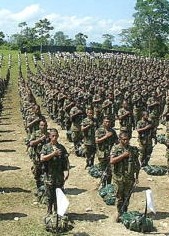
Colombia’s Justice and Peace Law (JPL) lies at the heart of the country’s efforts to dismantle notorious paramilitary groups and provide justice to thousands of their victims. As the government seeks to reform the JPL to allow for a more effective process, ICTJ will run a series of features to provide a deeper insight into the background and successes and challenges of the law.

In seeking to establish accountability for past atrocity, many transitional justice mandates have also sought to redress crimes against indigenous populations. To further explore this relationship, ICTJ and our partners in Canada and Colombia are holding two side events to the UN Permanent Forum on Indigenous Issues.

The conviction of former Liberian president Charles Taylor for crimes against humanity and war crimes committed in neighboring Sierra Leone finds both West African countries and the region grappling with his terrible legacy. And while the people, and especially Taylor’s victims, in Sierra Leone welcome it as an important step in the country’s effort to overcome the consequences of the brutal civil war, Liberians are still a long way from seeing accountability for the suffering they endured.

The conviction of Thomas Lubanga is a milestone for the international criminal justice system and may make an important contribution to the development and definition of the right to reparations in international human rights law. Accompanying a submission filed with the ICC in advance of its reparations proceedings, ICTJ has produced a briefing note examining what lessons the court can learn from the broader transitional justice field.

The conviction of Thomas Lubanga is a milestone for the international criminal justice system established by the Rome Statute, and may make an important contribution to the development and definition of the right to reparations in international human rights law. ICTJ has produced a br...

The National Conference to Launch a Dialogue on Transitional Justice in Tunisia was held on Saturday, April 14 in Tunis, initiating a process which should result in the adoption of a comprehensive law on transitional justice by the country’s National Constituent Assembly. ICTJ president David Tolbert delivered a keynote address.

On April 9, Colombia commemorated for the first time the National Day of the Memory and Solidarity with the Victims. This photo gallery collects the expressions of commemoration that took place in three cities in the country: Bogotá, Medellín and Villavicencio.

Colombia marked the country’s first National Day of Memory and Solidarity with the Victims April 9. For the millions who have suffered human rights violations in Colombia’s entrenched armed conflict, this was a day for their voices to be heard and their suffering to be acknowledged by the state; a nationwide call for accountability and reconciliation in a highly divided society.

NEW YORK, March 22, 2011—The International Center for Transitional Justice (ICTJ) congratulates Pablo de Greiff, director of ICTJ’s Research Unit, on the nomination as the first UN Special Rapporteur on the promotion of truth, justice, reparation and guarantees of non-recurrence of serious crimes and gross violations of human rights.