262 results

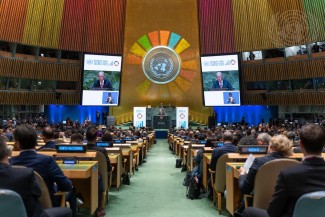
On September 18 and 19, world leaders gathered in New York for the UN Sustainable Development Goals Summit to take stock of the progress that the global community has made toward achieving the 2030 Sustainable Development Agenda and the challenges it still faces. At the summit, the UN General Assembly adopted a political declaration, which asserts that the achievement of the SDGs is “in peril,” describing progress toward them as moving too slowly and even regressing in some countries as a result of multiple, overlapping crises, such as persistent armed conflict. The international community must go further in specifying the obstacles that societies affected by conflict and widespread abuses face and the role that human rights can play in overcoming them.

In advance of the 2023 SDG Summit, the Working Group on Transitional Justice and SDG16+ has released a new report underscoring the contribution of transitional justice to the advancement of sustainable peace and development and offering stakeholders strategies to better incorporate it into relevant agendas and action plans. The SDG Summit marks the halfway point of the 2030 Agenda for Sustainable Development and offers the global community an opportunity to take stock of the progress it has made and the challenges it still faces in achieving the Sustainable Development Goals.

International policymakers recognize that transitional justice is an important component of the 2030 Agenda for Sustainable Development, especially in countries affected by systemic violence, repression, and marginalization. Yet responses to massive human right violations often remain...

Cover image of the report Toward Victim-Centered Change: Integrating Transitional Justice into Sustainable Peace and Development. It features several black lines that lean slightly to the right. A single yellow at the far right stands straight.

More than 20 years after the end of the Yugoslav Wars of the 1990s, Kosovo is still contending with unresolved ethnic tensions. Formerly an autonomous region of Serbia within the former Yugoslavia, Kosovo declared independence in 2008. Ethnic tensions were a root cause of the violent conflicts, during which an estimated 140,000 died and numerous atrocities were committed. ICTJ recently sat down with ICTJ's Anna Myriam Roccatello and Kelli Muddell to learn more about ICTJ's work and the present challenges to truth and justice in the country.

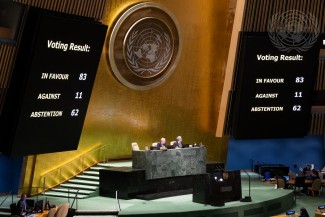
On June 29, 2023, the United Nations General Assembly adopted a resolution creating a new independent institution on the missing in the Syria Arab Republic. Eighty-three member states voted in favor, 11 voted against, and 62 abstained. ICTJ welcomes the resolution, which represents a momentary reprieve in Syria’s otherwise bleak justice landscape. This vote represents a critical step forward in supporting all those who seek answers about the fate and whereabouts of their loved ones and who suffer daily from the indignities and grave hardships that ensue when a loved one goes missing.

Eight years ago, the United Nations General Assembly declared June 19 as the International Day for the Elimination of Sexual Violence in Conflict in an effort to raise awareness about this endemic tactic of war; honor the innumerable victims and survivors across the world, as well as those working to end these violations; and ultimately eradicate this dehumanizing practice. History has shown that whenever there is a political or security crisis juxtaposed with a militarized response, conflict-related sexual violence is deployed as a tactic to subdue, dehumanize, and terrorize civilians and opponents.

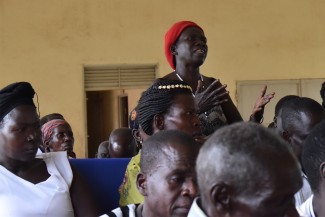
This report presents the findings from research on the needs and expectations of women survivors of sexual and gender-based violence in Nepal. Based on in-depth interviews, it explores what happened to these survivors during the country’s decade-long war (1996-2006), what they need no...

A cartoon illustration of a group of people

In societies grappling with conflict or repression, LGBTQ+ individuals are often targeted with violence and discrimination and experience some of the cruelest human rights violations. In 2022, Colombia Diversa began collaborating with members of ASFADDES, a prominent association of relatives of the missing or disappeared in Colombia. In June, 24 representatives from the two organizations met in Bogotá to for a series of workshops in which they exchanged knowledge and best practices and developed a better understanding of how to search for missing or disappeared LGBTQ+ persons.

The International Center for Transitional Justice (ICTJ) and the Committee of the Families of the Kidnapped and Disappeared in Lebanon (CFKDL) will release Windmills of Our Hearts, a new book of short stories by 15 women relatives of missing and forcibly disappeared persons in Lebanon. On June 1, ICTJ and CFKDL will host a public launch and book signing event at Dar el Wardieh in Hamra, Beirut.

This year marks the 50th anniversary of the hip hop movement. To honor its contributions to the struggle for justice, truth, and equality, the Skoll Foundation hosted a panel discussion and concert event featuring hip hop artists, including cofounder of the legendary rap group Run-DMC Darryl McDaniels and Colombian rapper and producer Ali aka Mind, as part of its 20th World Forum held in April in Oxford, United Kingdom. ICTJ, which received the Skoll Award for Social Innovation in 2009 and has partnered with the Skoll Foundation since, invited Ali aka Mind as a representative of Rexistencia Hip Hop, an artistic mentorship and creation lab led by ICTJ’s office in Colombia and the Latin American media outlet and foundation Cartel Urbano.