


756 results

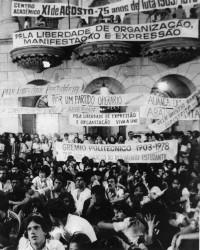
Brazil’s new government is showing strong support for the passage of a bill creating a National Truth Commission investigating past human rights violations, writes Eduardo González, director of ICTJ's Truth and Memory Program. ICTJ also spoke with Marlon Weichert, human rights activist and regional prosecutor for Brazil's Federal Public Ministry, on the current debate surrounding truth-seeking and accountability in Brazil.

ICTJ spoke with Marlon Weichert, prominent human rights advocate and regional prosecutor with the Federal Public Ministry of Brazil (Ministério Público Federal), on Brazil's pending truth commission bill and calls for accountability measures addressing past violations in Brazil.

As the United States and Colombia near the signing of a free-trade agreement and resolve differences over labor rights and other issues, the problematic extraditions of paramilitaries accused of savage crimes committed during the years of counter-insurgency remain far from the spotlight.

In the aftermath of massive or systematic violations or more generalized conflict,providing reparation in a meaningful way poses a daunting challenge. This 15 page paper covers the nature and objectives of reparations, forms of reparations, policy design of reparations, and financing...

South Africa’s Constitutional Court recently made a landmark ruling on the right to speak the truth about crimes amnestied by the Truth and Reconciliation Commission. ICTJ Truth-Seeking Consultant Howard Varney speaks about the ruling and its significance for South Africa and other countries.

Given that women represent a very large proportion of the victims of conflicts and authoritarianism, it makes sense to examine whether reparation programs can be designed to redress women more fairly and efficiently and seek to subvert gender hierarchies that often antecede the confli...

Women face a double marginalization under authoritarian regimes and during and after violent conflicts. Nonetheless, reparations programs are rarely designed to address the needs of women victims. What Happened to the Women? Gender and Reparations for Human Rights Violations, arg...

Part of a series of practitioner-oriented publications by OHCHR, focused on the establishment and implementation of reparations programs. Download the PDF from the OHCHR website

Most comprehensive book-length study of reparation programmes currently available, including case-studies, thematic chapters, and national legislation documents. Contains contributions from an international and cross-disciplinary group of leading scholars and practitioners. Provides a...

This publication is intended to assist in the implementation of principles contained in international human rights documents and treaties. It is a practical tool to provide guidance on implementing reparations initiatives. Its focus is not on redressing single or isolated human rights...